

Research Task: Large Scale Image-Making
Updated: Apr 23
Andreas Gursky

I couldn't find anything that I enjoyed or that resonated from the list of artists, apart from Andreas Gursky. Once I had clicked into a couple of his photos I was hooked. The scale, the detail, the point of view, the composition, the format, literally everything oozed style. It's inspired!
Fascinated by the scale of the photos, I was interested to learn how it was possible to capture such imagery. They appear seamless, natural, and convincing as one image shot from a camera, yet with there being no distortion at all. When considering panoramic photos, especially those taken on your phone, you often find that there is some level of distortion to the image. They warp at the edges, or depending on the perspective, can experience exaggerated distortion. I sometimes find it interesting to use panoramic for portrait format photos rather than landscape. Taking the level at which you stand, and then panning the camera up, giving an incredibly towering picture that I think can lends itself to describing literal scale of buildings of objects from your POV. Here is an example of a photo I had taken from the time Yayoi Kusama had towered over the streets in London.

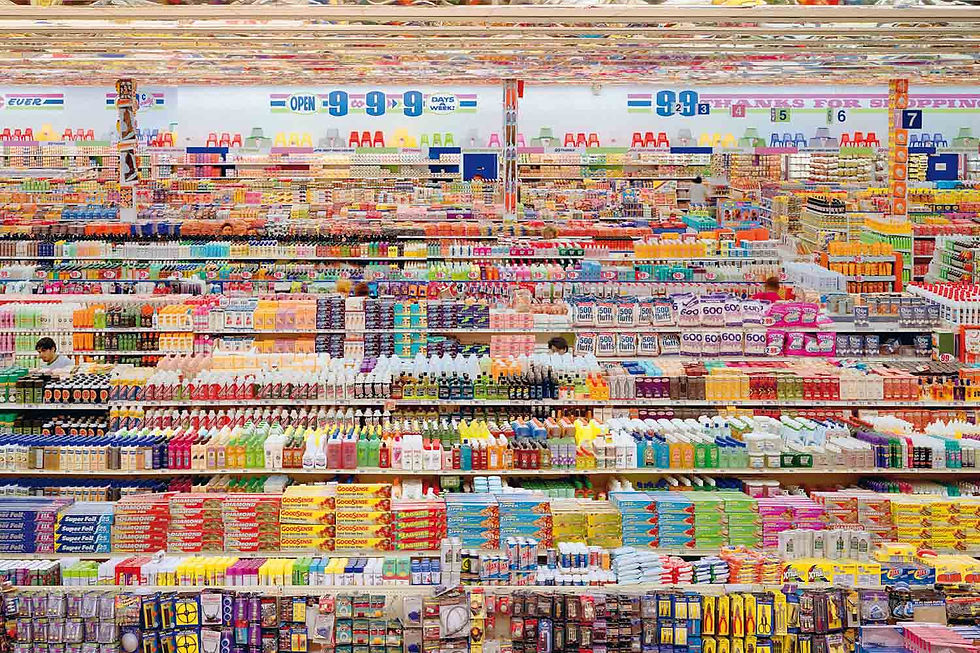
After watching several videos about Gursky's works, one recurring theme was the impossibility of seeing his works in their entirety. When looking at the simple phone image above, it's evident that due to its scale, you can't view it all clearly at once. Your eye moves across the image, absorbing parts as you go. If you focus on one area, the edges become blurred in your vision. It's incredible to see his photos, albeit on screen at a much smaller scale, and still find it hard to take it all in. They are sharp all the way to the edge, detailed in every part with only the slight blur if the subject is in motion. Achieving this is only possible by stitching images together, which I quickly learned is the case.
While studying Gursky's work, I discovered that he is known for using large format cameras, such as the Linhof Technorama 617 and the Arca-Swiss 4x5. Although Gursky is recognised for digitally altering his images during post-production, he still captures his works on film.
"Recently, I’ve been working with unsharpness. I was on a road trip with my wife, driving to Utah. Like any tourist, I was impressed by the landscape. One day I took pictures with my iPhone as we drove. I liked them. When we arrived at the hotel , I said to my wife: “OK, tomorrow you drive and I’ll try to get similar images at a higher resolution with my professional equipment.” The resulting image – of a flat, dry landscape with mountains in the distance – is mostly out of focus, though the resolution is high. It has a completely different perspective to my earlier works, which are sharp throughout."
Gursky chooses to focus on the man-made, with a particular interest in globalisation and capitalism. The use of large scale allows the composition to capture the enormity of modern spaces and reflect the complexity of contemporary global life.
"All my landscapes are manmade. My interest lies in people, civilisation, human presence and activity."

It would seem, and actually it is something I am reflecting on whilst working on Exercise 3 "big", that patience for large scale is in great demand, which feels to be true even with photography. To create the above image so perfectly, Gursky must have spent many hours in firstly planning and preparing the photo, actually taking the images, and then secondly, stitching them together and editing them in post-production. Not only is the number of windows that exists in this frame, it's the flatness of the building, the perfectly straight lines from the rooftop down to the road, and all the lines in between that create perfectly detailed grids. It's incredibly meticulous and precise that it just feels like so much time and effort had gone in to making it, which is interesting considering photography is often a very fast process. Powerful photos can make you pause and appreciate the subject matter, but Gursk'y work not only makes you appreciate the subject matter, but also almost forces you to actually feel time.
What's also fascinating about this photo is that each window will tell it's own story, and yet every single one exists at the same time, held in this moment, just as it does in reality. The scale and detail, I can only imagine, will allow you to see through those windows and witness what is or is not there. It's like a TV show with multiple storylines that coexist. when considering the photo in this perspective, it really is beautiful, and yet, the literal building and surroundings are not beautiful at all.
It would be incredible to see his photos in person, to experience the scale and power of them in real life. To see how sharp the image are, and how carefully considered they are in capturing a moment. I was sad to learn that I had missed an exhibition of his last year at the White Cube, and will now keep an eye out for any future exhibitions.
LINKS


